
Home
Meet the Team
Invisalign
Dental Emergencies
Canadian Dental Care Plan
Blog
Contact Us
Book Now

A dental implant replaces a missing tooth from the root up. It is the only option that does.
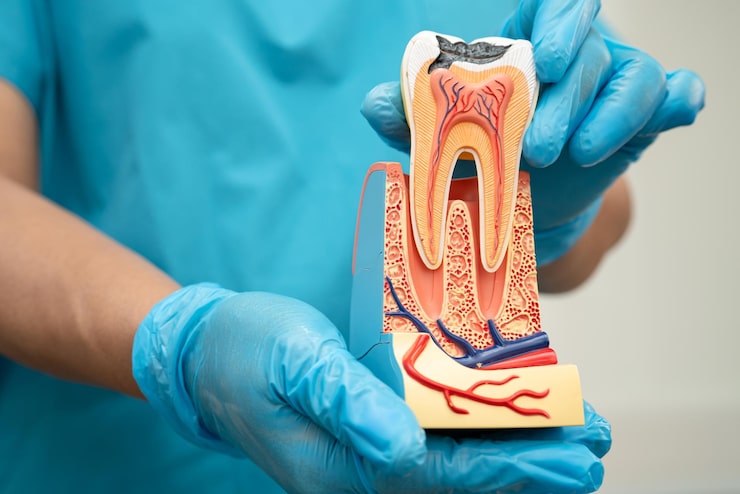
A small titanium post is placed into the jawbone, where the root used to sit. Over the next few months, bone grows against that post and locks it in place. Dentists call this osseointegration. Once the post is stable, a dental crown goes on top.
So a finished implant has three parts: the post in the bone, a connector called an abutment, and the tooth you see and chew with. The post carries your bite force straight into the bone. That keeps the bone working — which is why implants help limit the bone shrinkage that follows tooth loss.
One implant can replace one tooth. Two or more can carry a bridge across a bigger gap, or anchor a full set of implant-supported dentures. Which suits you depends on how many teeth are missing, how much bone you have, and your general health. We check all three at your first visit.
Your teeth hold each other in place. Each one is braced by the teeth beside it and by the tooth it meets when you bite.
Take one away and that balance goes. The teeth on either side slowly tilt into the space. The tooth above or below it can drift into the gap too.
That matters for more than looks. Tilted teeth are harder to clean, so plaque collects in the new angles. And a bite that no longer meets evenly puts more load on a few teeth instead of spreading it around.
The bigger change happens where you cannot see it.
Jawbone is kept alive by use. Every time you chew, the tooth root pushes that force into the bone, and the bone rebuilds itself in response. Remove the tooth and that signal stops. The ridge of bone that held it starts to narrow and shrink.
Most of that shrinkage happens in the first year. It then carries on slowly. Over time, and especially where several teeth in one area are missing, the jaw gives less support to the cheeks and lips.
It also affects your options later. The more bone that has gone, the more likely you will need a graft before an implant can be placed.
An implant replaces the root as well as the crown. That does two things a bridge cannot: it keeps the bone underneath in use, and it leaves the neighbouring teeth alone. A conventional bridge has to be carried by the teeth either side, so those teeth get reshaped and crowned.
Whether an implant is right for you is a clinical decision, not an automatic one. It depends on how much bone you have and its quality, the health of your gums, any medication that affects healing, and whether habits like grinding need sorting out first.
A dental implant is a small screw-shaped post. It is usually titanium, and it sits in the bone beneath your gum where the tooth root used to be.
Titanium is used for one reason: bone bonds directly to it instead of treating it as foreign.
Nothing goes on top straight away. The post is left to fuse with the bone for about three to six months. How long depends on the site and the quality of the bone there. Only once that bond has formed do we fit the abutment and make the final tooth.
What goes on top depends on the gap. One missing tooth takes a crown. Several in a row can take an implant-supported bridge carried on two or three posts, so you do not need an implant for every tooth. A whole arch can be restored with implant-supported dentures that clip onto a few implants.
An implant is a big decision, and it takes months rather than weeks. We would rather you knew the whole sequence — including the waiting — before you commit.
A missing tooth changes how you eat, how you speak, and how the rest of your mouth behaves over time. A gap often makes chewing uncomfortable on that side. Most people then favour the other side and load it harder than it was built for.
Implants are well studied. Research following single implants over ten years generally reports survival rates around 95%.
Results do vary. Where the implant sits in the mouth matters, as do the health of the gum and bone, smoking, and how well the implant is looked after afterwards. No implant is guaranteed. If we think the odds in your case are less good than that, we will say so.
The idea sounds worse than the appointment usually is.
The area is fully numbed first, so placing the implant should not hurt. Most people describe pressure and vibration rather than pain. A single implant usually takes 30 to 60 minutes. The most common complaint is having to hold your mouth open.
If dental treatment makes you anxious, tell us before we plan anything. Sedation options are available, and the consultation is the time to talk about them — not the day itself.
What the first week is usually like. Expect some swelling and tenderness for two or three days, and occasionally bruising. It normally peaks around day two, then eases. Most people manage on over-the-counter pain relief and go back to work the next day. We would ask you to skip hard exercise for a few days.
You will get written aftercare instructions before the freezing wears off — what to eat, how to clean the area, and which symptoms mean you should phone us.
After that, healing carries on quietly for a few months while the bone fuses to the post. You are not always left with a gap in the meantime. Depending on the site, we can often fit a temporary tooth while you wait.

The dental implant procedure is likely more comfortable than you may think.
Your first visit is an assessment, not treatment. We check the gum and bone at the site and look at the teeth either side. A 3D scan lets us measure how much bone is there and see exactly where the nerve and sinus sit. A scan of your teeth shows us the angle the implant needs, so the final tooth meets your bite properly.
This visit is also when we find out whether you will need a bone graft or a sinus lift first. We go through your medical history and any medication that could affect healing. You leave knowing the sequence, the timeline and the cost, before anything is booked.
The area is fully numbed. We make a small opening in the gum, prepare the bone to the exact width of the post, and place the implant. Depending on the case, the gum is either closed over the implant or left with a small healing cap showing through.
Stitches are not always needed, and when they are, they often dissolve on their own. If you are having a graft, it is done at the same appointment. A single implant usually takes 30 to 60 minutes, and you go home the same day.
The implant is then left to fuse with the bone, usually for three to six months. We check on it during that time rather than leaving you to wait unseen.
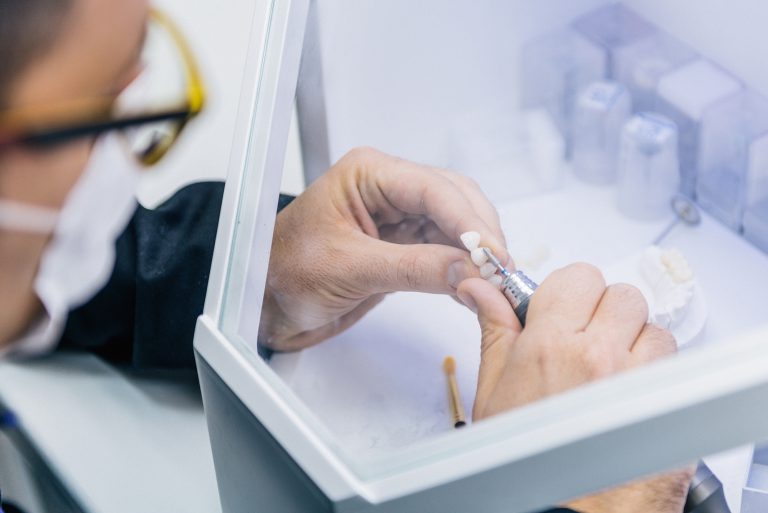
Once the bond is confirmed, we fit the abutment and take a scan of the finished implant position. The laboratory uses that to build your new tooth. At the last visit we fit the crown, bridge or denture and adjust it so it meets your other teeth evenly. From then on, you care for it like the rest of your teeth.
An implant cannot decay. But the gum and bone holding it can still become inflamed.
That is called peri-implantitis. It behaves much like gum disease around a natural tooth, and it is the most common reason an implant is eventually lost. It is also largely preventable.
Day to day, brush twice a day and clean between the teeth around the implant with floss or an interdental brush — the same as everywhere else. At your exam and cleaning we check the gum around the implant, look at how it meets your bite, and take the occasional X-ray to confirm the bone level is holding.
Two other things help. Smoking clearly raises the risk of implant problems, so if you have been thinking about stopping, this is a good time. And if you grind or clench, a night guard protects the new tooth from forces it was not built for.
In Stouffville, the cost of a single dental implant typically ranges from $3,000 to $6,000+, while full-mouth reconstructive implants can range from $6,000 to $60,000 or more. The average cost for a full set of implant-supported dentures is around $30,000. Keep in mind that no dental practice can provide an accurate quote over the phone, as the procedure is highly complex and depends on individual factors.
What that figure covers. An implant is not one item on a bill. The fee normally reflects three stages: placing the post, the abutment, and the final crown or other restoration. The 3D scan and planning are part of it too.
Preparatory work is costed separately — an extraction, a bone graft or a sinus lift. That is a common reason two quotes for “an implant” are not comparing the same thing.
Insurance and the Canadian Dental Care Plan. Private plans vary a lot. Some pay toward the crown but not the surgery, and many have an annual maximum that one implant will use up on its own.
The Canadian Dental Care Plan does not list implants among its covered services. It does cover some of the alternatives, including dentures and crowns with preauthorization. We give you a written plan with the item codes on it, so you can get a predetermination from your insurer before you decide.
Since every case is unique, it’s essential to schedule a consultation for a detailed oral exam. This will help us assess your specific needs and provide an accurate quote with different treatment options to consider.
The biggest single variable is whether the site is ready as it is. Where a tooth has been gone for years and the ridge has narrowed, a graft adds cost and several months. That is one good reason to ask about implants when a tooth is being removed, rather than years later.
The number of implants does not rise in step with the number of teeth, either. A full arch is usually restored on four to six posts, not one per tooth.
For one to three missing teeth in a row, a dental bridge may be an option. For bigger gaps or a full arch, removable or implant-supported dentures are worth considering. Each has its place. The right answer depends on your bite, your bone, your budget, and how much upkeep you want.
A bridge is quicker — a few weeks rather than several months — and costs less up front. The trade-off: it is carried by the teeth either side, which have to be reshaped and crowned. And the bone under the gap is still not being used, so the ridge keeps shrinking underneath it.
A removable denture is the least invasive and the least expensive, and it can replace many teeth at once. It comes out for cleaning and rests on the gum rather than in the bone. It needs relining or remaking now and then as the ridge changes shape.
An implant costs more at the start and takes longer. In return it stands on its own, leaves the neighbouring teeth alone, and keeps the bone in use. You look after it like a natural tooth, and many stay in service for decades.
There is a fourth answer that is sometimes the right one: leave the gap alone. A missing back molar with nothing biting against it does not always need replacing. If that applies to you, we will tell you.
A restoration is the visible “false tooth” that covers the implant, making it look like you have a new, natural tooth. It is made separately from the post underneath and fitted once the implant has fused. That means it can be replaced later, if it ever needs to be, without disturbing the implant itself.
to schedule an initial consultation & exam.
Your consultation will include an examination of everything from your teeth, gums and soft tissues to the shape and condition of your bite. Generally, we want to see how your whole mouth looks and functions. Before we plan your treatment we want to know everything about the health and aesthetic of your smile, and, most importantly, what you want to achieve so we can help you get there.
No, dental implants are designed to blend seamlessly with your natural teeth. The implants themselves are hidden beneath the gums, and the restorations are customized to match the rest of your smile.
Dentures and implants serve different purposes. Dentures rest on the gums, while implants are securely fixed below the gums, strengthening your bite. Both options have their pros and cons. We recommend visiting us to determine the best treatment for your needs.
If you’re not a candidate for implants, dental bridges or full/partial dentures can replace missing teeth. We can discuss your options during a consultation to find the best solution for you.
Candidates must be adults with good oral health and a strong jawbone. Healthy gums are also important to reduce the risk of complications. If you’re unsure, call us to discuss your options and determine if you’re a candidate for dental implants.
Yes! Your dental implant will be custom-made to match your natural teeth in shape, size, and colour, ensuring a seamless look.
The procedure is generally predictable and pain-free. With modern techniques, discomfort is minimal, and recovery is quick. We’ll ensure you’re comfortable throughout and provide aftercare instructions to minimize any discomfort.
Most patients return to work the day after surgery. We’ll provide a more accurate recovery timeline based on your treatment plan and let you know if any time off is needed.
We recommend checkups every 6 months, though the frequency may vary depending on your specific needs and how well you care for your implants.
Treat your implants like natural teeth. Brush, floss regularly, and keep up with professional cleanings and checkups to ensure their longevity.
No, implants are designed to last a long time with proper care and maintenance. They do not need to be replaced unless there are complications.