
Richmond Hill Dental Implants: The 3D Scan, the Bone Check, and Your Quote

Dental Implants•November 9, 2026•Renova Dental

Short answer: A dental implant can’t be quoted accurately over the phone. A proper first visit covers three things: a 3D scan that measures your jawbone and maps the nerve and sinus, a bone and gum check that shows whether a graft is needed first, and a written plan that lists every stage of the cost. For patients from Richmond Hill and across York Region, our dental implants in Stouffville page explains how treatment works at our office.

If you are comparing Richmond Hill dental implants, those three steps are what make one quote comparable with another. This guide explains each one in plain language, so you know what to expect and what to ask.

At Renova Dental, on Main Street in Stouffville, Dr. Parisa Tavakoli and our team walk you through every stage before anything is booked.

Dr. Parisa Tavakoli beside the dental chair in a Renova Dental treatment room

What Is a Dental Implant?

A dental implant is a small titanium post placed in the jawbone where a tooth root used to be. Over a few months, the bone grows against the post and locks it in place. Dentists call this osseointegration.

Once the post is stable, an abutment (a small connector) and a crown go on top. Because the post carries your bite into the bone, an implant helps limit the bone shrinkage that follows tooth loss.

An implant also stands on its own, so the healthy teeth beside the gap are not reshaped, as they would be for a traditional bridge. Our guide to dental bridges vs implants compares the two, and Dental Implants 101 covers the basics.

Whether an implant is right for you is a clinical decision. It depends on how much bone you have, the health of your gums, any medication that affects healing, and habits like grinding. That is exactly what the first visit is for.

Richmond Hill Dental Implants: What Happens at the First Visit?

Your first visit is an assessment, not treatment. Nothing is placed that day, and you leave knowing the sequence, the timeline, and the cost before anything is booked.

At that visit, we:

  1. Check the gum and bone at the gap, and look at the teeth on either side.
  2. Use a 3D scan of the jaw to measure how much bone is there and see exactly where the nerve and sinus sit.
  3. Scan your teeth with our iTero scanner, so the final tooth can be lined up with your bite.
  4. Go through your medical history and any medication that could affect healing.
  5. Find out whether you need a bone graft or a sinus lift before the implant goes in.

Then it goes in writing. You get a plan with the item codes on it, so you can compare it with another quote and ask your insurer what they will pay.
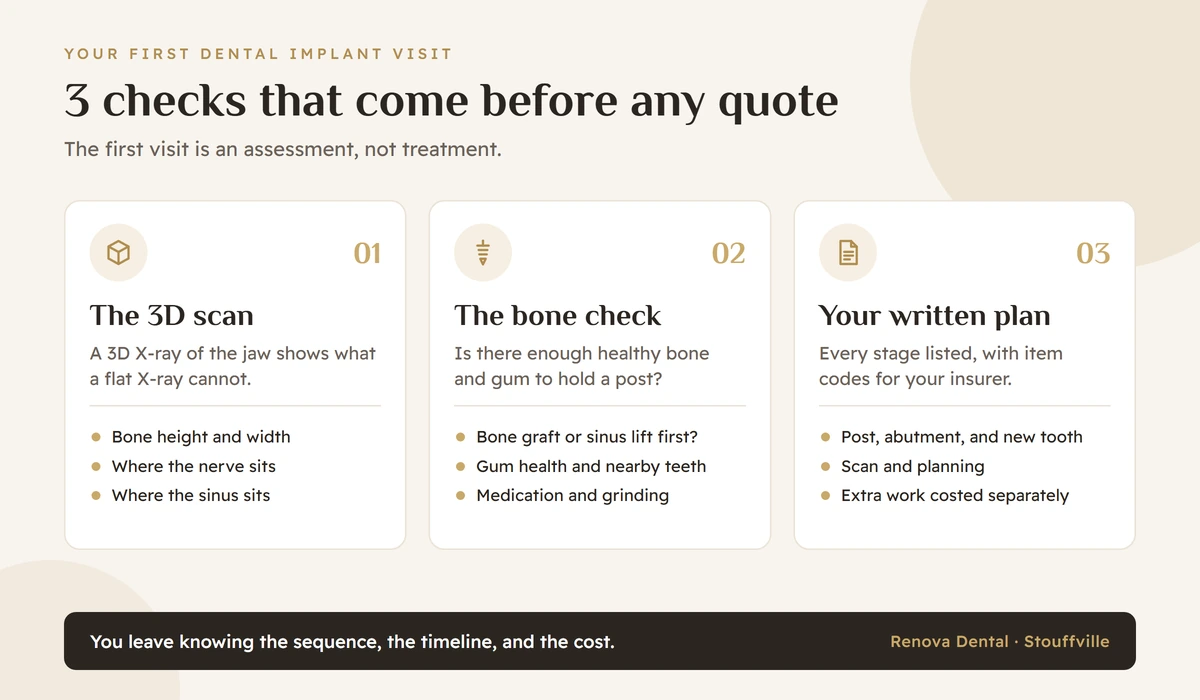
Richmond Hill dental implants assessment: the 3D scan, the bone check, and the written plan that come before any quote

Why Do You Need a 3D Scan Before an Implant?

A 3D scan shows the height and width of the bone and the exact position of the nerve and sinus. That lets the implant be sized and angled to fit the bone safely, with room to spare.

A regular dental X-ray is a flat, two-dimensional picture. It cannot show how wide the bone is from cheek to tongue.

For implant planning, dentists use a cone-beam CT (CBCT) scan, a 3D X-ray of the jaw. The U.S. Food and Drug Administration lists dental implant planning among the main uses of dental CBCT.

The same FDA page notes that a dental CBCT exam typically delivers more radiation than a regular dental X-ray, but less than other CT exams.

Is the iTero Scan the Same Thing?

No. Our iTero scanner is an optical scanner. A small handheld wand records the shape of your teeth and gums in 3D, with no putty trays and no radiation.

It shows the surface, not the bone. For an implant, that surface scan helps us set the angle of the post, so the final tooth meets your bite and lines up with the teeth around it.

How Do You Know if You Have Enough Bone for an Implant?

The exam and the 3D scan answer that at the first visit. We look at bone height and width, gum health, the neighbouring teeth, and your medical history.

Jawbone stays healthy through use. Every time you chew, the tooth root pushes force into the bone, and the bone rebuilds itself in response. When a tooth is lost, that signal stops, and the ridge of bone that held it starts to narrow.

The change is faster than most people expect. A 2012 systematic review in Clinical Oral Implants Research found the ridge lost 29% to 63% of its width and 11% to 22% of its height within six months of an extraction. The fastest change came in the first three to six months.

At your assessment, we check:

  • Bone height and width: is there enough bone to hold an implant securely?
  • Gum health: healthy gums lower the risk of complications around an implant.
  • The teeth on either side: are they healthy, and how do they meet your bite?
  • Your medical history: including any medication that could affect healing.
  • Grinding or clenching: if you do, a night guard protects the new tooth from forces it was not built for.

What If You Need a Bone Graft or a Sinus Lift?

If the bone has thinned, you may need a bone graft, or a sinus lift for an upper back tooth, before or during implant placement. It adds some time and cost, but it gives the implant a solid foundation.

The first visit tells you whether you need one, so you know before treatment starts. Where a tooth has been gone for years and the ridge has narrowed, a graft can add several months.

That is one good reason to ask about implants when a tooth is being removed, rather than years later. The sooner the site is assessed, the more bone there usually is to work with.

Want to know whether an implant suits your gap?

What Should a Dental Implant Quote Include?

A complete implant quote covers the post, the abutment, the final tooth, and the 3D scan and planning. Extractions, bone grafts, and sinus lifts are costed separately. That is the most common reason two quotes for Richmond Hill dental implants do not compare the same thing.

ItemWhat it isIn the implant fee?
Implant postThe titanium post placed in the boneUsually included
AbutmentThe connector between the post and the toothUsually included
Crown, bridge, or dentureThe teeth you see and chew withUsually included
3D scan and planningMeasures the bone and maps the nerve and sinusUsually included
ExtractionRemoving a failing tooth firstCosted separately
Bone graft or sinus liftRebuilding bone so the post has supportCosted separately

The number of implants doesn’t rise in step with the number of missing teeth, either. Several teeth in a row can be replaced with an implant-supported bridge on two or three posts, and a full arch is usually restored on four to six.

A removable implant denture can also clip onto two small implants. It still comes out for cleaning, but it is held in place instead of relying on suction. Our dentures page explains the options.

Dr. Parisa Tavakoli holding a model of a full set of teeth at Renova Dental

For typical fees and what changes them, read our dental implant cost guide. Flexible financing options are also available for larger treatments.

Will Insurance or the CDCP Pay for an Implant?

Private dental plans vary a lot. Some pay toward the crown but not the surgery, and many have an annual maximum that one implant can use up on its own.

The Canadian Dental Care Plan’s list of covered services does not include implants. It does cover some alternatives, including complete dentures, and partial dentures and crowns with preauthorization. Our CDCP page explains how it works at Renova Dental.

Because your written plan carries the item codes, you can ask your insurer for a predetermination before you decide. We also bill insurance directly, which keeps things simple.

What Do Implant Placement and Healing Feel Like?

Most people feel pressure and vibration rather than pain, because the area is fully numbed first. A single implant usually takes 30 to 60 minutes, and you go home the same day.

If dental work makes you anxious, tell us at your consultation, not on the day itself. Sedation options are available, and the consultation is the time to talk about them.

Expect some swelling and tenderness for two or three days, and occasionally bruising. Most people manage with over-the-counter pain relief and go back to work the next day. You get written aftercare instructions before the freezing wears off.

How Long Does It Take to Get a Dental Implant?

For a single implant, plan on about three to six months from placement to the final crown. A bone graft can add several months.

  1. Assessment: the exam, the 3D scan, the scan of your teeth, and your written plan.
  2. Extraction or graft, if needed: a bone graft or sinus lift may come first, or be done at the same appointment as the implant.
  3. Placement: the post goes in, usually in 30 to 60 minutes.
  4. Healing: the bone fuses to the post over about three to six months. We check on it during that time, and we can often fit a temporary tooth so you are not left with a gap.
  5. Final tooth: we fit the abutment, scan the implant position for the lab, and then fit your crown, bridge, or denture.

Planning Richmond Hill Dental Implants at Renova Dental

Renova Dental is at 6284 Main Street in Stouffville. If you live in Richmond Hill and are planning an implant, here is what you can expect from us:

  • A clear plan first: the 3D scan, the bone check, and a written plan come before anything is booked.
  • Digital tools: iTero scanning, digital X-rays, and an intraoral camera, with your images on the screen beside the chair.
  • Hours that fit around work: we are open Saturdays, and until 7 p.m. on Wednesdays and Thursdays.
  • Direct billing: we bill your insurance directly and accept the CDCP for covered services.

See our dental implants page for what treatment involves from consultation to final crown.

To book an implant assessment, call us at (905) 591-9569 or contact us online.

Frequently Asked Questions

How long does the dental implant process take?

Most single implants take about three to six months from placement to the final crown, because the bone needs time to fuse with the post. A bone graft can add several months. You get your own timeline at the assessment.

Do I need a 3D scan for a dental implant?

Yes. A 3D scan shows how much bone is at the site and exactly where the nerve and sinus sit. It lets the implant’s size, angle, and position be planned around them, and it shows early whether you need a bone graft.

Is an iTero scan the same as a 3D X-ray?

No. An iTero scan uses light to record the shape of your teeth and gums, with no radiation, while a 3D X-ray (CBCT) shows the bone, nerve, and sinus. Implant planning uses both: one for the bone, and one for how the new tooth meets your bite.

How do I know if I need a bone graft?

The exam and 3D scan at your first visit show whether there is enough bone height and width. A graft is more likely where a tooth has been missing for years, because the ridge narrows after an extraction, fastest in the first three to six months.

What should a dental implant quote include?

It should include placing the post, the abutment, the final crown, bridge, or denture, and the 3D scan and planning. Extractions, bone grafts, and sinus lifts are costed separately, so check that two quotes cover the same items.

Does the CDCP cover dental implants?

No. The Canadian Dental Care Plan does not list implants among its covered services. It does cover complete dentures, and partial dentures and crowns with preauthorization.

Does getting a dental implant hurt?

The area is fully numbed, so most people feel pressure rather than pain. Expect swelling and tenderness for two or three days. Most people use over-the-counter pain relief and go back to work the next day.

Where is Renova Dental, and when is it open?

Renova Dental is at 6284 Main Street in Stouffville, Ontario. We are open Monday and Tuesday 8 a.m. to 5 p.m., Wednesday and Thursday 9 a.m. to 7 p.m., and Friday and Saturday 8 a.m. to 3 p.m. We are closed on Sundays.

New Patients Welcome

Ready to take care of your smile?

Book your visit with Renova Dental in Stouffville — CDCP accepted and insurance billed directly.

Book Your Appointment →

Keep Reading

More From Our Blog