
Is Invisalign Covered by Insurance in Canada? How Orthodontic Benefits Work

Invisalign•November 18, 2026•Renova Dental

Short answer: Often in part. Invisalign is usually claimed under your dental plan’s orthodontic benefit, the same benefit that pays for braces. Plans with orthodontic coverage commonly pay 50% of the cost up to a lifetime maximum, sometimes for children only. Without that benefit, Invisalign usually isn’t covered, and the CDCP doesn’t currently cover orthodontics.

Is Invisalign covered by insurance? For most people in Canada, the answer sits in one line of the benefits booklet: orthodontics. This guide explains how that benefit works, what a lifetime maximum means for your share of the cost, how two plans and government programs fit in, and what to ask your insurer before you start.

At Renova Dental on Main Street in Stouffville, Dr. Parisa Tavakoli and our team give you an accurate quote after an exam, so you can see what your insurance will cover before you decide on Invisalign in Stouffville.

Dr. Parisa Tavakoli at the front desk of Renova Dental in Stouffville

Is Invisalign Covered by Insurance in Canada?

Yes, often in part, if your dental plan includes orthodontic benefits. If it doesn’t, Invisalign is usually not covered at all.

Orthodontic coverage is the part of a dental plan that pays toward straightening teeth. The Canadian Association of Orthodontists notes that it is often a separate benefit in a dental insurance contract, and that it is often reimbursed at 50%, up to a maximum dollar amount.

It sits apart from the basic and major coverage that pays for cleanings, fillings, and crowns. So the useful question isn’t “Does my plan cover Invisalign?” It’s “Does my plan include orthodontics, and who does it cover?”

Invisalign is generally claimed under orthodontics, the same benefit used for braces, rather than as a benefit of its own. Ask your insurer to confirm how your plan handles clear aligners.

How Do Orthodontic Benefits Work?

Orthodontic benefits pay a set share of the cost, up to a lifetime limit, for the people your plan covers. These are the terms you’ll see in your benefits booklet:

  • Coverage percentage: the share of the eligible cost the plan pays. 50% is common. You pay the rest.
  • Lifetime maximum: the most the plan will ever pay for orthodontics for one person. Once it’s used, it’s gone, even if you need treatment again later.
  • Age limits: some plans cover orthodontics only for dependent children up to a set age. Others include adults.
  • Waiting periods: some plans pay for orthodontics only after you have been enrolled for a set time.
  • Deductible: a small amount you pay each year before the plan starts paying.
  • Payment schedule: some insurers pay orthodontic benefits in instalments over the course of treatment, not all at once.
  • Predetermination: your treatment plan is sent to the insurer before you start, so it can confirm what it will pay.

What Does a Real Plan Pay?

One public example is the federal Public Service Dental Care Plan. Its summary on Canada.ca (updated October 2026) says it reimburses orthodontic treatment at 50% after the deductible, up to $3,000 per lifetime for 2025 and 2026. That limit rises to $3,250 on January 1, 2027.

The plan describes its orthodontic benefit as treatment of misaligned teeth with fixed or removable appliances. Your own plan may pay more or less, but the structure is typical: a percentage, a lifetime cap, and rules about who is covered.

A Simple Example

Say your plan pays 50% of orthodontics up to a $3,000 lifetime maximum.

  • $4,000 treatment: the plan pays $2,000, and you pay $2,000.
  • $6,000 treatment: the plan pays its full $3,000, and you pay $3,000.
  • $8,000 treatment: half would be $4,000, but the plan stops at $3,000, so you pay $5,000.

The lifetime maximum, not the percentage, is often what limits your claim. These figures are only an illustration and leave out the deductible. Your plan and your treatment plan set your real numbers.
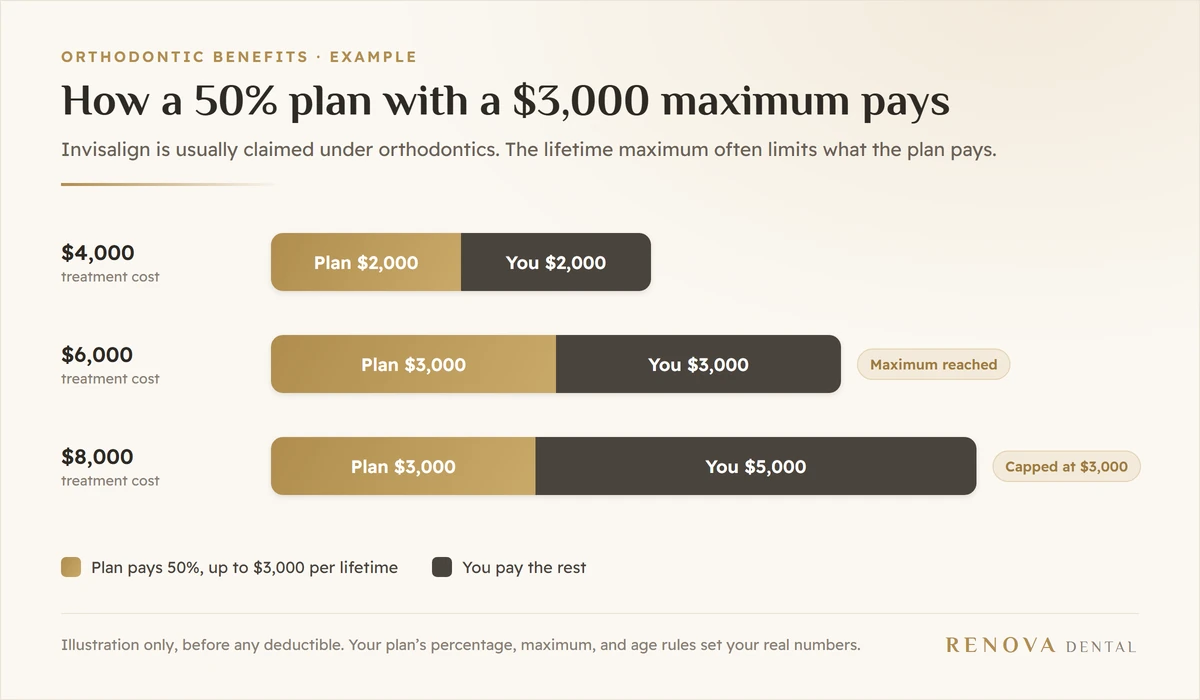
Is Invisalign covered by insurance? Chart of what a plan paying 50% up to a $3,000 lifetime maximum covers on $4,000, $6,000, and $8,000 treatments

Is Invisalign Covered by Insurance for Adults?

Sometimes. Some plans cover orthodontics only for dependent children up to a set age, while others include adults too. Check the age rules in your booklet before you assume either way.

That’s why a teenager on a parent’s plan can pay less out of pocket than an adult having the same treatment. If you’re an adult, look at both your own plan and any spouse’s plan, since either one could include adult orthodontics.

Starting Treatment for a Teen

If your teen is starting treatment, find out exactly when coverage ends. Some plans stop orthodontic benefits at a set age, so the start date can affect what the plan pays. Ask your insurer how it handles treatment that is still underway at that cut-off.

If you’re weighing aligners against brackets, our page on braces for teens and our guide to Invisalign vs braces explain the differences.

Can You Use Two Dental Plans for Invisalign?

Often, yes. If you’re covered by your own plan and a spouse’s plan, or your child is on both parents’ plans, the second plan may pay part of what the first one doesn’t. This is called coordination of benefits.

Canadian insurers generally follow a coordination of benefits guideline from the Canadian Life and Health Insurance Association (CLHIA). In practice:

  • For yourself: claim first under your own plan, then send the balance to your spouse’s plan.
  • For a child: the plan of the parent whose birthday (month and day) comes first in the calendar year usually pays first.
  • The total limit: together, the two plans can’t pay more than the eligible cost of treatment.

Because each plan has its own orthodontic maximum, two plans can pay noticeably more than one. Ask both insurers how they coordinate orthodontic claims before treatment starts.

Do the CDCP or OHIP Cover Invisalign?

No. Neither government program currently pays for Invisalign.

The Canadian Dental Care Plan (CDCP) helps eligible residents without private dental insurance pay for many dental services. However, its coverage page on Canada.ca (updated August 2026) states that orthodontic services are currently not available.

Renova Dental accepts the CDCP for covered services, such as exams and cleanings. Our CDCP page explains who qualifies and how it works at our office.

OHIP covers only certain dental surgery done in a hospital. It doesn’t pay for treatment in a dental office, so it doesn’t cover Invisalign.

What Else Can Lower Your Invisalign Cost?

If your plan has no orthodontic coverage, or you’ve reached your maximum, a few other options can reduce what you pay.

OptionCan it help?What to know
Dental plan with orthodonticsOften, in partCommonly 50% up to a lifetime maximum; check the age rules
Health spending accountOften, if your employer offers oneCan usually cover the share your dental plan doesn’t pay
Medical expense tax creditYes, for eligible costsClaim only the part no plan reimbursed
Payment options at our officeYesThe full cost isn’t due all at once
CDCP or OHIPNoOrthodontic treatment isn’t covered

The medical expense tax credit: the Canada Revenue Agency’s list of eligible medical expenses includes orthodontic work. You can claim only the part that insurance didn’t reimburse, and purely cosmetic procedures don’t qualify, so check with a tax professional about your situation.

Payment options: at Renova Dental, the full cost of Invisalign isn’t due all at once, and we’re happy to go over the payment options with you. Our Invisalign cost guide shows typical prices in Canada and what changes them.

Want to know what your plan would pay toward Invisalign?

How Do You Check Your Invisalign Coverage?

Five checks in your benefits booklet or online portal tell you most of what you need to know:

  1. Find “orthodontics” in your booklet or member portal. If it isn’t listed, your plan probably doesn’t cover Invisalign.
  2. Note the percentage, the lifetime maximum, and any age limit.
  3. Check for a waiting period if you joined the plan recently.
  4. Ask how much of the lifetime maximum is left, for example if you had braces years ago.
  5. Ask for a predetermination with your treatment plan, so you have the plan’s share in writing before you start.

Questions to Ask Your Insurer

  • Does my plan include orthodontic coverage, and does it apply to clear aligners like Invisalign?
  • What percentage does it pay, and what is the lifetime maximum?
  • Is there an age limit or a waiting period for orthodontics?
  • Do you pay orthodontic claims all at once or spread over the treatment?
  • If I’m also on my spouse’s plan, how do the two plans coordinate?

How Does Renova Dental Help With Your Benefits?

We keep the insurance side simple, so you can focus on whether Invisalign is right for you.

  • A clear quote: after an exam, we give you an accurate quote, so you can see what your insurance will cover and what you’ll pay yourself.
  • A digital scan, not putty: your treatment plan starts with a 3D scan on our iTero scanner, which can also show a preview of how your smile could look.
  • Predetermination paperwork: when your insurer asks for a pre-authorization, your digital X-rays and images can be sent electronically.
  • Direct billing: we bill most major insurance plans directly, which means less paperwork for you.

The Renova Dental team at the reception desk in Stouffville

To see whether clear aligners suit your smile, visit our Invisalign in Stouffville page. We’re at 6284 Main Street in Stouffville, open Saturdays and until 7 p.m. on Wednesdays and Thursdays. Call (905) 591-9569 to book an Invisalign consultation.

Frequently Asked Questions

Is Invisalign covered by insurance in Canada?

Often in part, if your dental plan includes orthodontic benefits. Those plans commonly pay 50% of the cost up to a lifetime maximum. Without orthodontic coverage, Invisalign usually isn’t covered.

Does insurance cover Invisalign for adults?

Sometimes. Some plans cover orthodontics only for dependent children up to a set age, while others include adults. Check your benefits booklet or ask your insurer.

What is an orthodontic lifetime maximum?

It’s the most your plan will ever pay for orthodontic treatment for one person. For example, the federal Public Service Dental Care Plan’s limit is $3,000 for 2025 and 2026. Once it’s used up, the plan pays nothing more for orthodontics.

Can I use two dental plans for Invisalign?

Often, yes. Your own plan pays first, and the second plan may pay part of the balance, up to its own limits. Together, they can’t pay more than the eligible cost.

Does the CDCP cover Invisalign?

No. The Government of Canada says orthodontic services are currently not available under the Canadian Dental Care Plan. The CDCP still covers many other services, such as exams and cleanings.

Can I claim Invisalign on my taxes?

Often, yes. The CRA lists orthodontic work as an eligible medical expense, but you can claim only the part no plan reimbursed. Purely cosmetic procedures don’t qualify, so ask a tax professional.

Should I get a predetermination first?

Yes, it’s a good idea. A predetermination shows what your insurer will pay before you start, so there are fewer surprises. We can send the images your insurer needs electronically.

New Patients Welcome

Ready to take care of your smile?

Book your visit with Renova Dental in Stouffville — CDCP accepted and insurance billed directly.

Book Your Appointment →

Keep Reading

More From Our Blog